
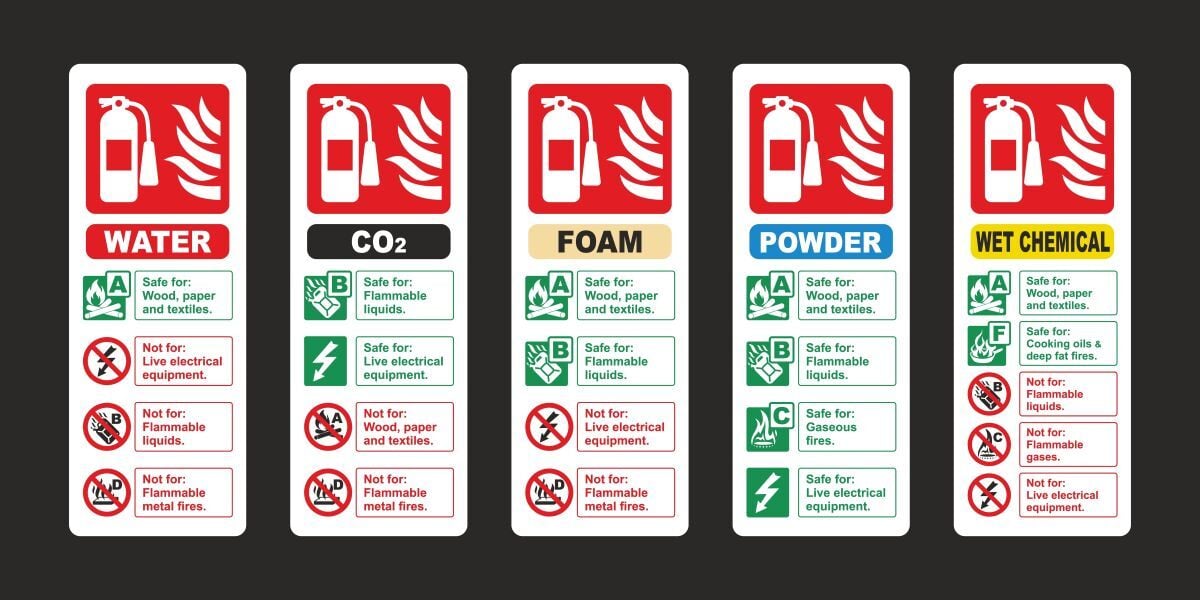
Every fire extinguisher has a label—but for many people, it might as well be a foreign language. Between the letters, numbers, and pictograms, it’s easy to get confused about what the extinguisher is actually designed to do. Yet in an emergency, those details can mean the difference between putting out a fire safely or making it worse.
In this blog, we’ll break down each part of a fire extinguisher label so you can read it like a pro and select the right unit for your home, business, or facility.

- Understanding Fire Class Ratings (A, B, C, D, K)
The most important part of the label is the fire class rating, which tells you what kinds of fires the extinguisher is designed to fight.
- Class A: Ordinary combustibles like wood, paper, and cloth.
- Class B: Flammable liquids and gases such as gasoline, grease, propane, or oil.
- Class C: Electrically energized equipment and wiring.
- Class D: Combustible metals like magnesium, titanium, and sodium (common in industrial environments).
- Class K: Cooking oils and fats, typically in commercial kitchens.
Pro Tip: Most offices and homes use multipurpose ABC extinguishers, while restaurants need specialized Class K units for kitchens.
- Decoding the Numbers Before the Letters
On many extinguishers, you’ll see a number before the letter (e.g., 2-A:10-B:C). These numbers indicate the relative firefighting capacity:
- Class A number: Represents the equivalent to 1.25 gallons of water. For example, “2-A” means it can put out roughly twice that much Class A fire as a “1-A”.
- Class B number: Represents the approximate square footage of flammable liquid the extinguisher can cover. For example, “10-B” means it can put out 10 square feet of a flammable liquid fire.
- Classes C, D, and K: These classes don’t use numbers—just letters. The presence of the letter means the extinguisher is effective against that fire type.
Pro Tip: Bigger numbers = more firefighting power, but also heavier extinguishers. Balance effectiveness with ease of use.
- The Pictograms: Quick Visual Guides
Modern extinguishers include pictograms that show what types of fires they can (and cannot) be used on. For example:
- A trash can and wood symbol = safe for Class A fires.
- A gas can = safe for Class B fires.
- A plug and socket = safe for Class C electrical fires.
- A star = safe for D metal fires.
- A pan = safe for kitchen fires.
- A red slash through a symbol = do not use on that type of fire.
These are especially helpful for employees or family members who might not remember the letter system.
- UL Listing and Why It Matters
Most extinguishers carry a UL (Underwriters Laboratories) mark, which means they’ve been independently tested and certified for safety and effectiveness.
- UL Rating: Confirms the extinguisher meets performance standards for its listed classes.
- Look for UL or FM (Factory Mutual): These marks are critical for code compliance, insurance, and reliability.
- Avoid non-certified units: Bargain extinguishers without certification may not work when you need them most.
- Manufacturer Information and Date Codes
The label also includes key details that help with compliance and maintenance:
- Manufacturer’s name and model number: Useful for reordering or service.
- Date of manufacture or last service: Extinguishers typically require annual inspections and may need hydrostatic testing every 5–12 years.
- Instructions for use: Most will outline the PASS method—Pull, Aim, Squeeze, Sweep.
Pro Tip: If you can’t find a date or the label is unreadable, it’s time to service or replace the extinguisher.
- Size and Weight Considerations
The label usually specifies the extinguisher’s capacity in pounds (e.g., 5 lb, 10 lb). Bigger extinguishers have more agent, but they may be harder for some employees to handle.
- 5 lb units: Common for offices, vehicles, and homes.
- 10–20 lb units: Better for warehouses, industrial spaces, and high-risk environments.
- Portable vs. wheeled: Larger facilities may need wheeled units rated up to 350 lb for industrial hazards.
- Putting It All Together: Real-World Example
Let’s look at a label that reads 4-A:80-B:C, UL Listed, 10 lb Dry Chemical Extinguisher.
- 4-A: Equivalent to 5 gallons of water for Class A fires.
- 80-B: Can handle 80 square feet of flammable liquid.
- C: Safe for electrical fires.
- UL Listed: Independently tested and approved.
- 10 lb unit: Provides strong firefighting power but may be heavy for some users.
This extinguisher would be ideal for a warehouse or factory setting with mixed hazards.
Confidence Through Clarity
Fire extinguisher labels aren’t just technical jargon—they’re life-saving instructions in disguise. By learning to read the ratings, pictograms, and certifications, you can select the right extinguishers for your environment and ensure they’ll be effective when you need them most. Not sure if your extinguishers meet code or match your facility’s risks? Koorsen Fire & Security can help. Contact us today for a professional assessment and training session.